 |
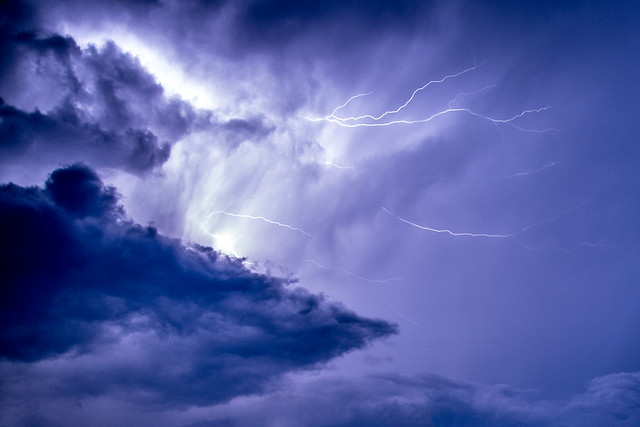
| Lightning peeking out of a cloud formation (see larger image) |
Showing posts with label photos. Show all posts
Showing posts with label photos. Show all posts
Wednesday, June 10, 2015
Lightning Storm

Wednesday, November 6, 2013
Scanning Negatives vs. Macro DSLR Copying
When I first started getting back into film after well over a decade of digital cameras, I ran across a guy that was absolutely convinced that no scanner could beat his method of "scanning" negatives and slides. He would use a macro lens attached to his digital camera, and photograph the negative in sections, merging them in software later. He posted an outline of his method on this page.
I was intrigued by this (and his amazing results), and decided to give it a try myself. I picked out a random black & white photo (to make reversal easier) that had a good sharp focus point on it. This photo was taken with my Mamiya C330 on Kodak TMax 400 film (120 format, 6x6).
I don't have an Epson V700, but I do have a Canon Canoscan 9000F Mark II to use as a comparison. It doesn't support any transparency larger than 120 film, but at around $150, it's a fraction of the cost. I scanned the frame at a (pretty ridiculous) 4800 dpi, which resulted in an image that was around 11600x11500, or about 127 megapixels. Of course, this is well beyond the limitations of the scanner's optics, but I will scale it down shortly for comparison purposes.
 |
| The test image, a number of books carved into a storefront in Mt. Dora, FL. |
I don't have an Epson V700, but I do have a Canon Canoscan 9000F Mark II to use as a comparison. It doesn't support any transparency larger than 120 film, but at around $150, it's a fraction of the cost. I scanned the frame at a (pretty ridiculous) 4800 dpi, which resulted in an image that was around 11600x11500, or about 127 megapixels. Of course, this is well beyond the limitations of the scanner's optics, but I will scale it down shortly for comparison purposes.
Monday, September 9, 2013
Rolleicord In Montréal
I brought a much fuller set of camera gear to Montréal during my latest business trip in March and April. I previously didn't think I'd have the room to pack a full bag of DSLR gear and a second backpack containing my work laptop, but this time around I made it happen. In fact, I was even able to bring along my treasured little Rolleicord III by wedging into a space next to my laptop in the second backpack.
While I didn't have quite as much play time as I had hoped on this trip, I still managed to get out a couple of times to enjoy the cold weather (I'm a Florida native so I can say "enjoy") and occasionally snap a photo or two. To be safe, I had all of the negatives processed before returning home, so there would be no chance of X-ray damage.
 While I didn't really come up with anything amazing while I was shooting with this camera, I did end up with a couple of decent shots. I think I might be too worried about being seen as something other than just a guy taking a picture, I don't know. I always want to sit still for a while and concentrate on a scene, gathering information and finding the composition that best speaks to me. Something about this bicycle spoke to me, with its odd mismatched brake levers and weird MacGuyver'ed rear mud guard, half buried in snow and forgotten over the long winter months in Montréal. There was a great photo here, and I knew it as soon as I saw it. But then I quickly started to feel self-conscious, wondering what those people down the street were thinking of this weird guy hanging out by someone's bicycle. Or wondering when someone was going to bust out running down the stairs with a baseball bat, mistaking me for a bike thief or creepy trespasser. As a result of that insecurity, I ended up sticking around just long enough to meter the scene, dial it in, and fire off a shot without spending any time on composing it. It left me with a photo that I didn't really love, and I still wonder what I would have ended up with if only I had spent more time.

Thursday, March 7, 2013
Recesky TLR DIY Kit
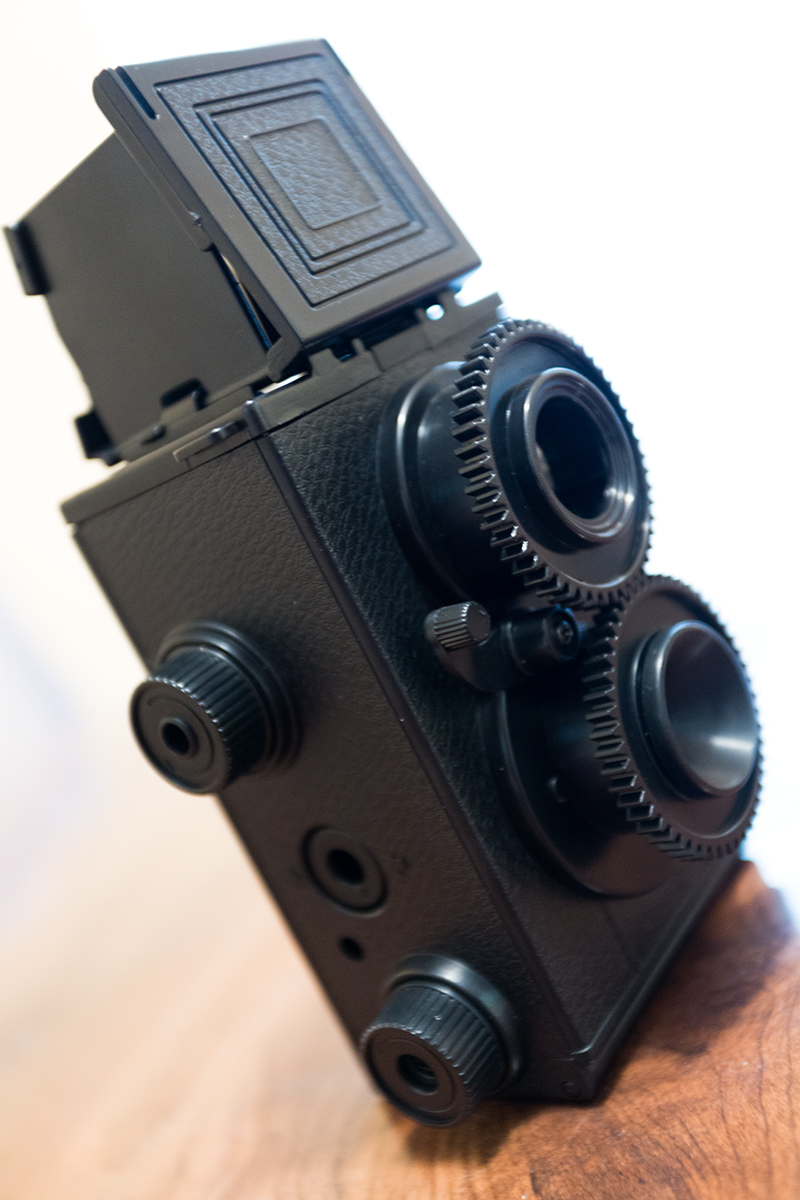 |
| Recesky DIY TLR, assembled. |
Everything is reduced to its component parts, so I found it pretty interesting, especially building out the shutter mechanism. Of course it's tragically basic, but it was still cool to put it all together and see it work.
Once fully assembled, you have a basic, no frills TLR; it has a flip-up hood that you can open to expose the matte waist-level finder, which like any TLR is reflecting an image back from the viewing lens (in reverse). The two lenses are linked by gear teeth so that when the viewing lens is being focused, the taking lens is focused by the same amount.
The shutter trips at what I can only imagine is a somewhat approximate 1/125 second, it's basically a spring-loaded piece of plastic that swings out and springs back when you press down on the shutter release lever, located at the front of the camera. The aperture is fixed at f/11, so really the only actual exposure control you have is changing up the film speed when you switch rolls.
Subscribe to:
Posts (Atom)