Showing posts with label macro. Show all posts

Tuesday, June 23, 2015

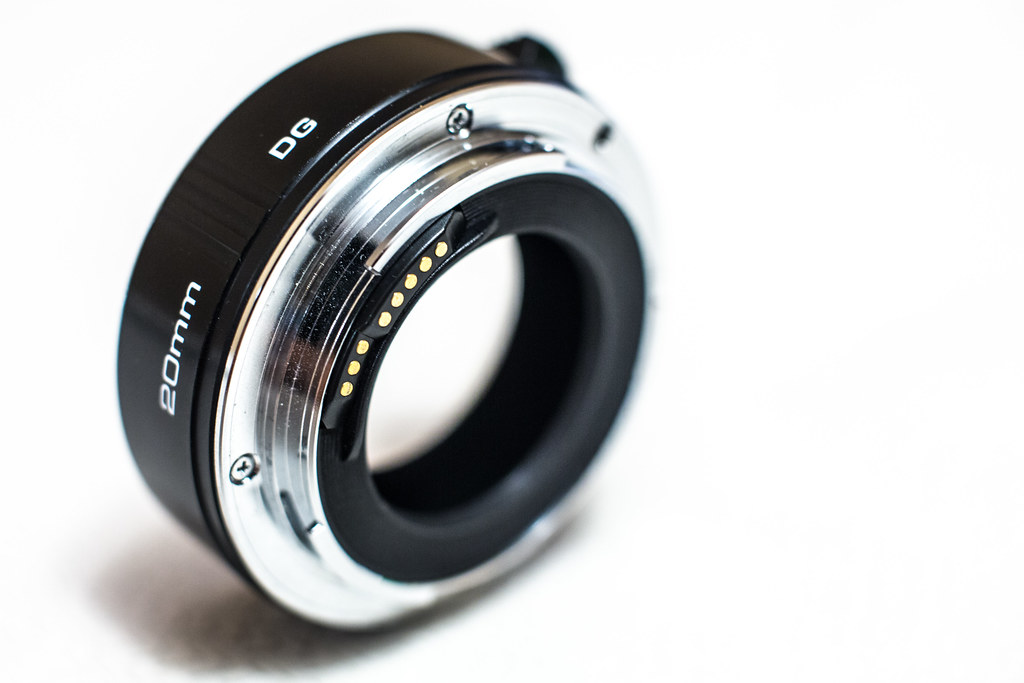
How Extension Tubes Work

There seems to be a lot of misconceptions out there regarding extension tubes and how they work, and if you're just getting started with them, it can be a little frustrating when you're not getting them to behave how you might expect.  I've talked a few people through it to clear up questions they had, so hopefully by writing up a post about it, it will help someone else one day.

Extension Tubes Are Just Spacers

An extension tube
Some years back, I ran across several product reviews for a set of extension tubes that were unnecessarily negative. The main reason was because the users expected to be able to "zoom in" farther with these tubes to allow the subject to better fill the frame. What they were probably thinking of was a teleconverter, which introduces additional lens elements to effectively increase the focal length of the lens it's attached to.  Extension tubes are different.  They have no optical elements at all; their only purpose is to add additional distance between the lens and the film plane. If you really wanted to, you could actually make your own extension tube with a cardboard toilet paper tube! That's how simple they are.

Wednesday, November 6, 2013

Scanning Negatives vs. Macro DSLR Copying

When I first started getting back into film after well over a decade of digital cameras, I ran across a guy that was absolutely convinced that no scanner could beat his method of "scanning" negatives and slides.  He would use a macro lens attached to his digital camera, and photograph the negative in sections, merging them in software later. He posted an outline of his method on this page.

Mount Dora Storefront
The test image, a number of books carved
into a storefront in Mt. Dora, FL.
I was intrigued by this (and his amazing results), and decided to give it a try myself.  I picked out a random black & white photo (to make reversal easier) that had a good sharp focus point on it. This photo was taken with my Mamiya C330 on Kodak TMax 400 film (120 format, 6x6).


I don't have an Epson V700, but I do have a Canon Canoscan 9000F Mark II to use as a comparison.  It doesn't support any transparency larger than 120 film, but at around $150, it's a fraction of the cost. I scanned the frame at a (pretty ridiculous) 4800 dpi, which resulted in an image that was around 11600x11500, or about 127 megapixels.  Of course, this is well beyond the limitations of the scanner's optics, but I will scale it down shortly for comparison purposes.