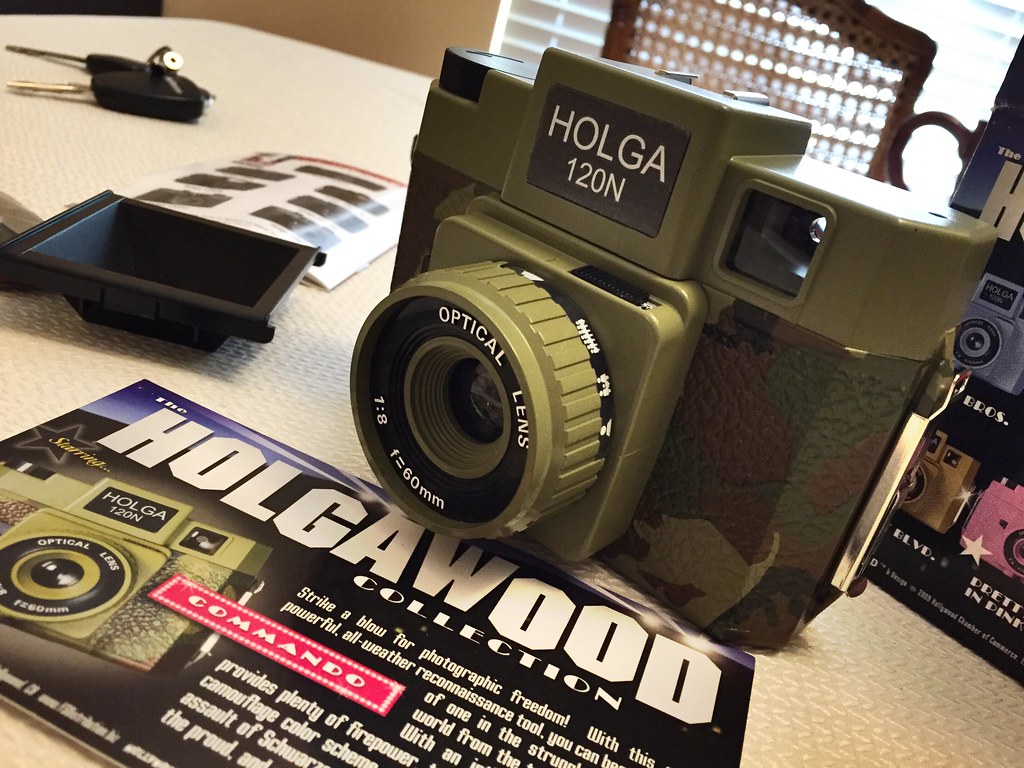
I'm not usually a toy camera kind of person. The couple that I have don't get much use, they're just not my style. But I recently won third place in a photo contest, and my prize was this olive camouflage "Holgawood Collection" Holga 120N, called "Commando". With the factory having shut down, I figured that at least now I'll get a chance to use one of these infamous little cameras before they are nowhere to be found (although now Freestyle says they're coming back?!).
Of course, I am aware of the Holga's "So Tragically Flawed It's Cool" status that makes it the darling of hipsters worldwide. In fact, even the user manual extolls the virtues of its plastic lens and probable light leaks as "stretching our visual perception" in ways a proper camera apparently cannot. The idea of random uncontrollable light leaks as a feature rather than a problem makes little sense to me, and I certainly don't think I'll be using the Holga as a primary camera for "real" shooting, but I do sort of get the allure of an all-plastic zone focus toy that requires little or no effort.
Random, mostly photography-related musings by some guy on the internet that you've never met.
Showing posts with label film. Show all posts
Tuesday, March 21, 2017
Friday, February 24, 2017
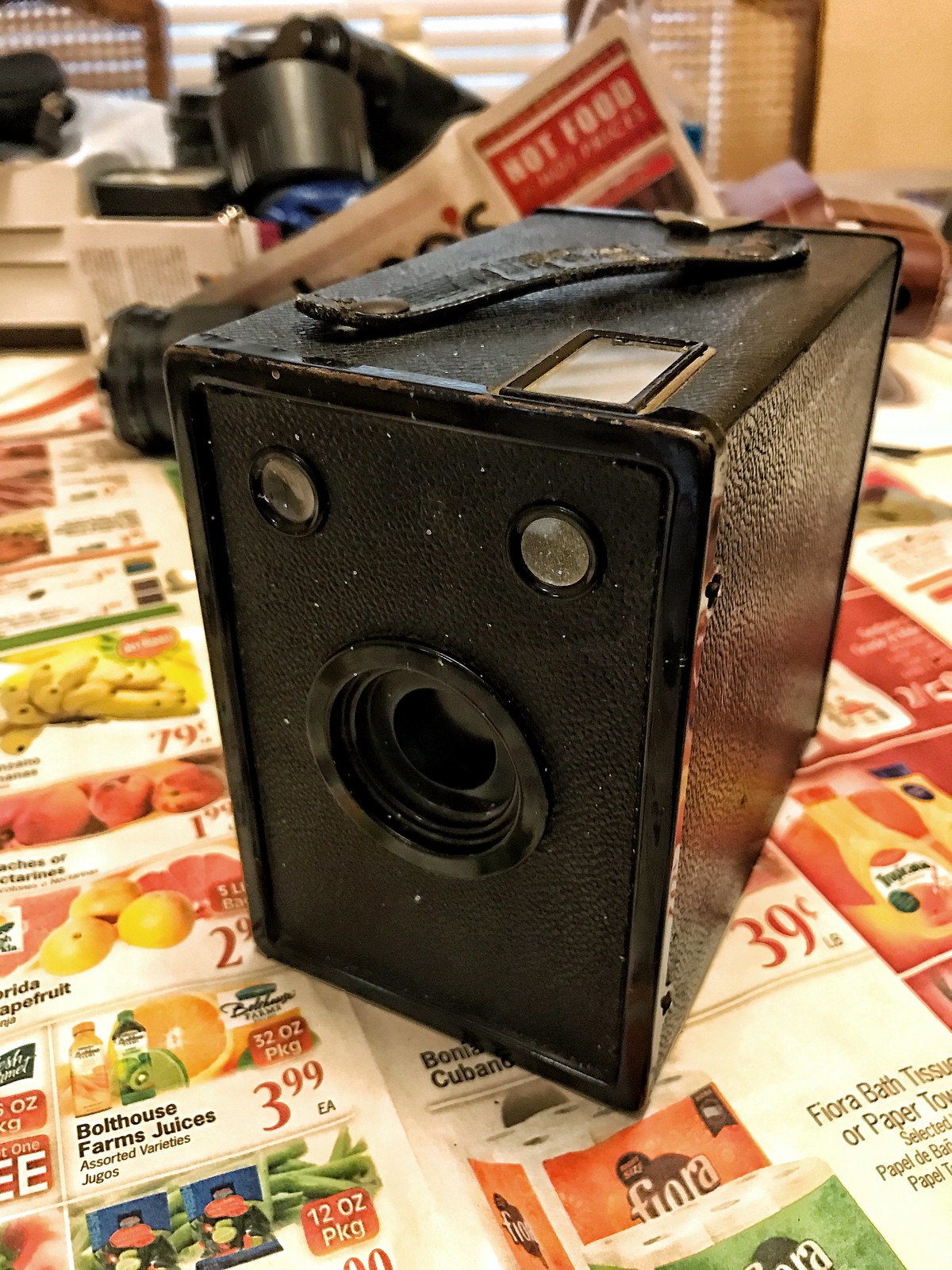
The Agfa Ansco D-6 Cadet
![]() |
| Agfa Ansco D-6 Cadet |
Thursday, June 16, 2016
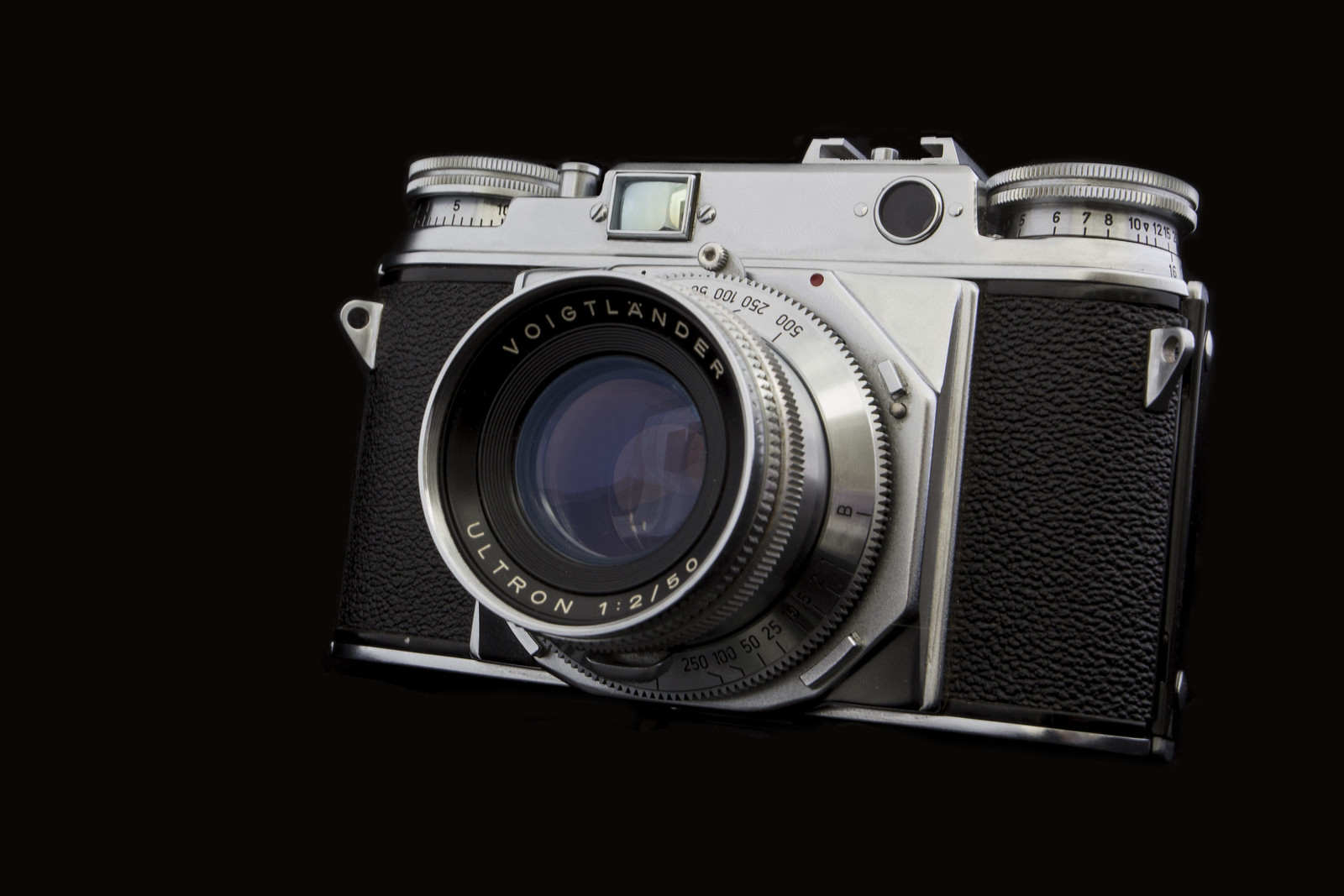
The Voigtländer Prominent: Strange Is Beautiful
I laughed a little to myself when I read the Craigslist ad, "We know how much it cost, but what is it worth?! Submit your offers and the highest bid will be accepted on April 5th!" The blurry, oddly angled photo taken in bad light betrayed little or no sense of its condition, and I just let it pass. Of course I wanted a nice 1950's era chrome rangefinder, but I'm not really willing to get into a bidding war over one. I've got plenty of cameras already.
Come On-a My House
April 5th came and went, and the ad was re-listed. Then it was re-listed again, and then again. No one was biting. Eventually curiosity got the best of me, and I sent an email asking what kind of price range he was looking for. He wanted $200, I politely declined with the excuse that I was just looking for something cheap to take on vacation with me, and I wished him luck.
Here's the fun part: when he heard I was actually going to be using the camera and not just putting it on display somewhere, he offered to give it to me for $100 and the assurance that I'd put it to good use. Apparently it belonged to a friend of his, a 91-year-old veteran that bought it while stationed in Germany sometime around 1951. He agreed to sell it for his friend, who was excited to hear that it might get some use again.
So the adventure began.
Friday, May 13, 2016
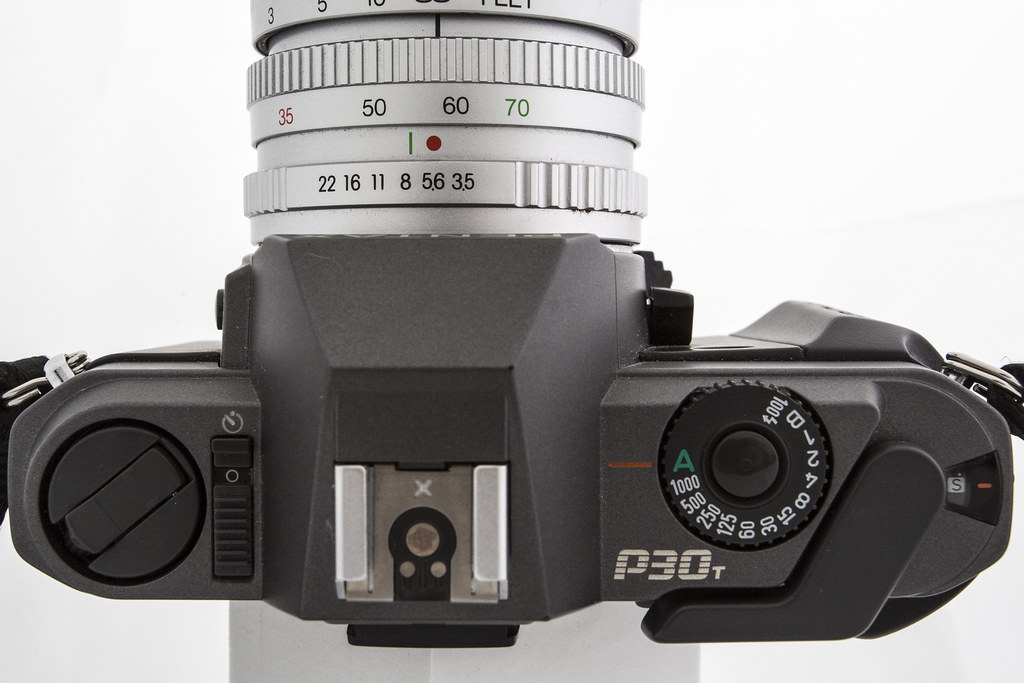
Camera Review: Pentax P30T
![]() |
| The Pentax P30T, attached to a lens from a Vivitar v4000 that suffered a sad fate. |
This camera looked like something from Blade Runner.
Wednesday, May 11, 2016
Film Photography & Digital Processing: Yes, You Should Edit Your Photos!
There seems to be a presumption, growing in popularity, that film photography is somehow more pure than digital photography. It's the idea that doing any processing on an image after scanning it from the negative is considered "cheating" because you're altering the image from its original, physical source. I'd like to try to clear up this misconception in my usual long-winded and rambling style.
Friday, February 19, 2016
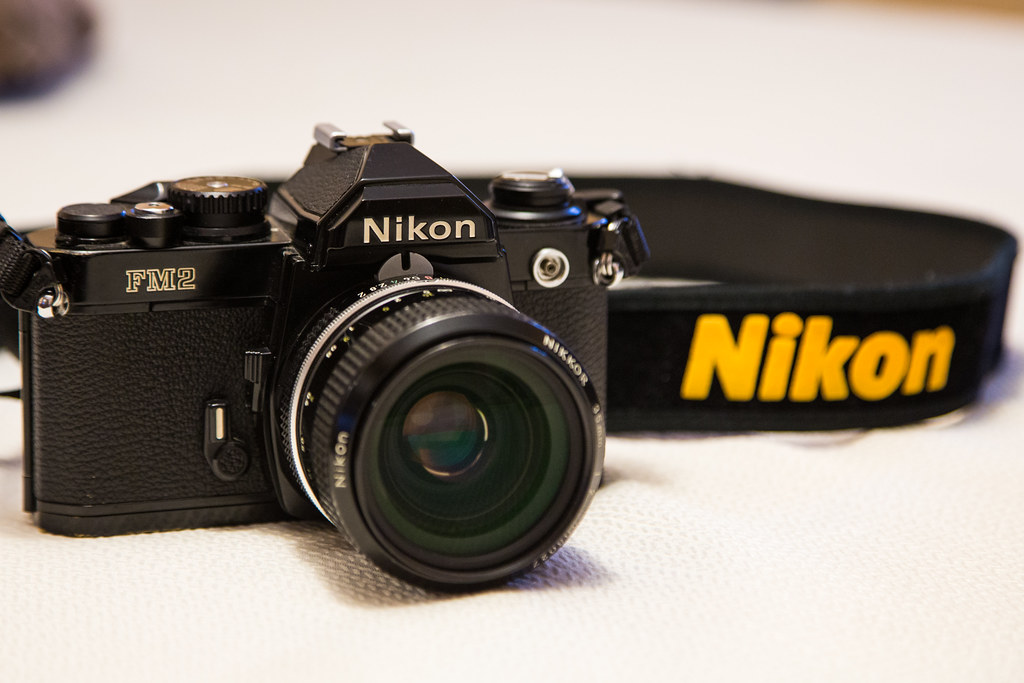
Camera Review: Nikon FM2n
The Nikon FM2n entered the world as a minor update to the groundbreaking FM2 in 1984. With an all-mechanical shutter reaching unheard-of speeds of 1/4000s, the FM2 is a camera that is already unique enough to be on my "want" list.
Early FM2n models saw only a couple of changes over the FM2, the most obvious being an update to the maximum flash sync speed from 1/200s to 1/250s. A new mirror stop was also added to the FM2n, as well as an extra light trap in the mirror box. Later FM2n's (from 1989 onward) also saw the titanium honeycomb-patterned shutter replaced with a smooth aluminum one.
Monday, February 8, 2016
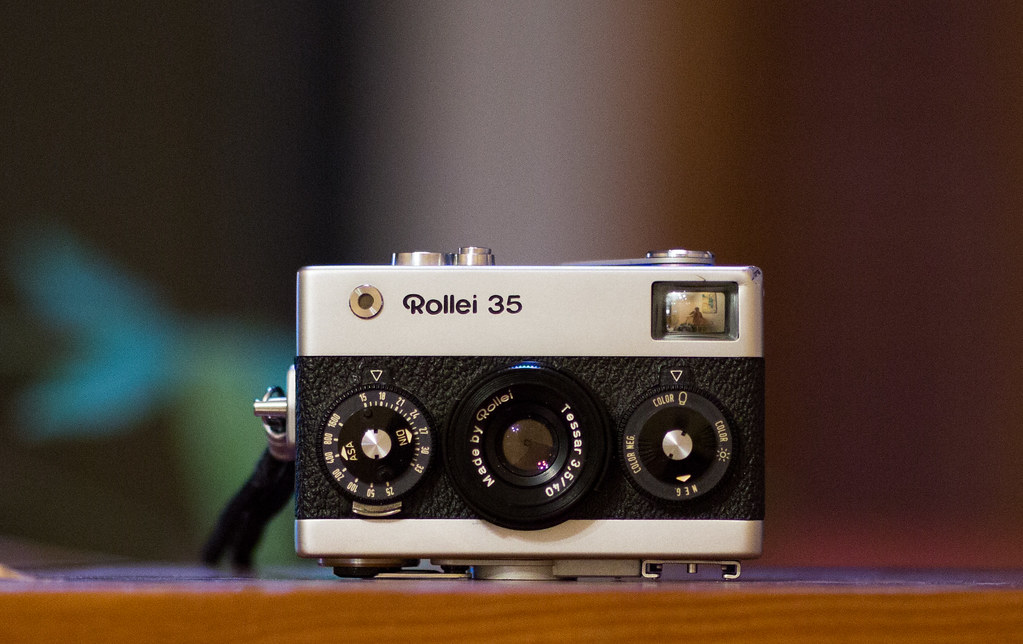
Camera Review: Rollei 35
Ah, the Rollei 35. People love it! They're going for about $150 on eBay right now, more than the price of many great SLR's. As for me, I'd have a hard time paying that much for one. Sure it has some great talking points, but never before has a camera made me feel so inadequate.
Wednesday, January 27, 2016
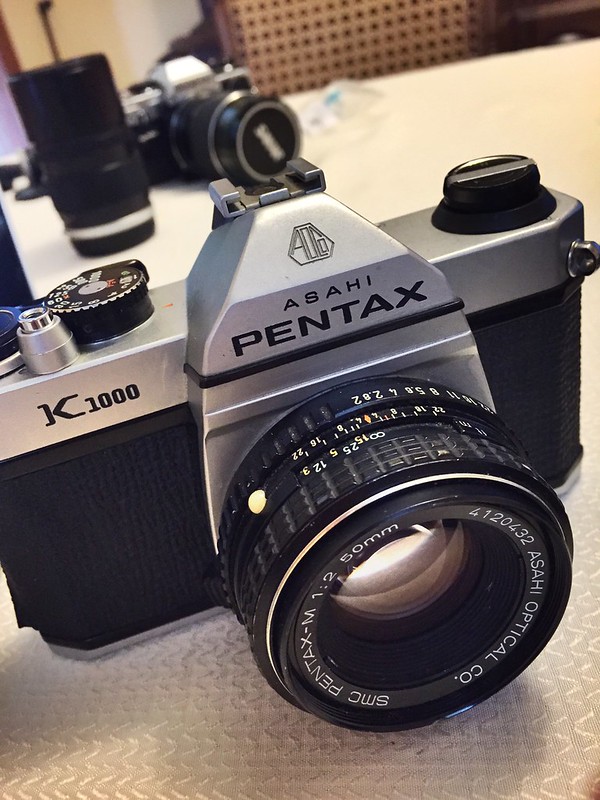
Camera Review: Pentax K1000 (and Asahi SMC Pentax-M 50mm f/2)
The Pentax K1000 has a reputation for being a solid, no-frills SLR that will probably outlast your children. It's a pretty accurate reputation. I bought mine off of an ex-student that had taken a college photography class and (of course) moved right on to a digital camera. I paid $25 dollars for it and an Asahi SMC 50mm f/2.0 lens. I'm going to include the lens in this review because otherwise it would be quite short. Of course, if you're not interested in that lens you can ignore the appropriate parts.Monday, January 25, 2016
Camera Review: Nikkormat FT2
![]() |
| Nikon FT2 with Nikkor 35mm f/2.0 |
Thursday, October 1, 2015
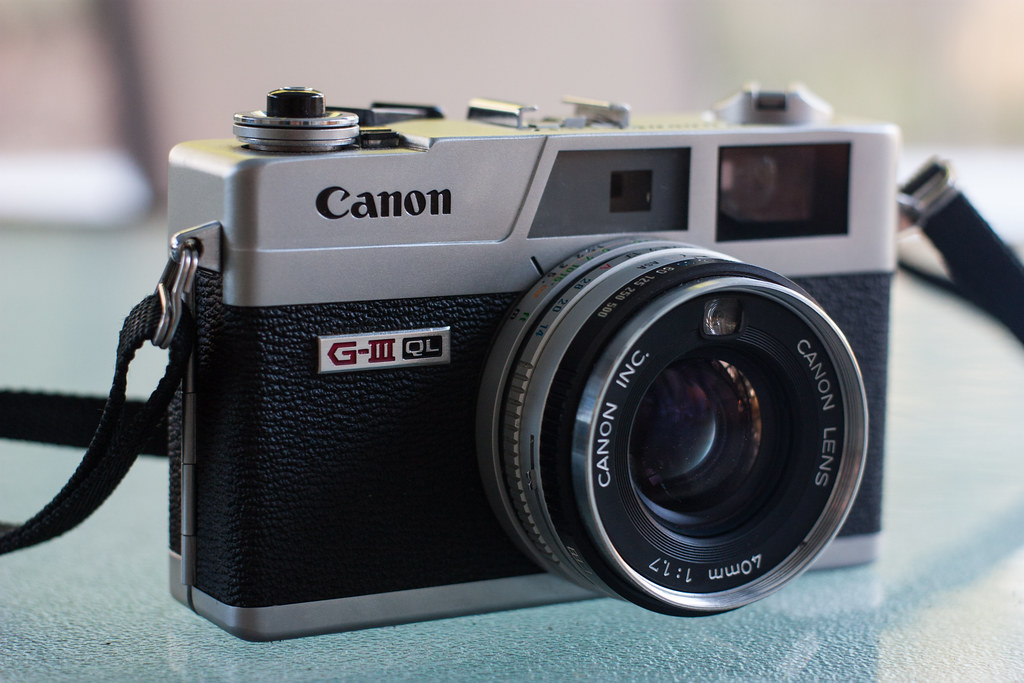
Camera Review: Canonet QL17 GIII 35mm Rangefinder
It took a while, but I finally got around to running a few rolls through my Canonet QL17 GIII 35mm rangefinder camera (purchased for $50!). I've already mentioned it in a couple of previous posts, including a short how-to on adjusting the rangefinder spot, but I never really got around to reviewing it. So here we are!
Monday, August 31, 2015
Canonet QL17, QL19, and QL28 Vertical Rangefinder Adjustment
I haven't even done a post on my relatively new-to-me Canonet QL17 GIII yet, but I thought I'd put up a quick guide on adjusting the rangefinder overlay. I just finished doing it, and it was quite a bit easier than I expected it to be.I noticed the problem when I first got the camera off of eBay. It was pretty minor, but I noticed that the overlay was vertically off just a little. So even when the focus level was maneuvered so that everything was perfectly lined up, it was still just a bit off. Of course, this doesn't affect focusing at all, since the focus moves the overlay horizontally rather than vertically, but it was a little annoying.
Wednesday, August 26, 2015
A Video Through the Eyes of a Mamiya C330
I adore my Mamiya C330, and so anything about that camera automatically clicks with me. And when that thing also happens to be unusually awesome, well... all the better.
This is a short video shot entirely through the waist-level finder of a Mamiya C330. How cool is that?!
Walk in the Woods from Daniel Regner on Vimeo.
This is a short video shot entirely through the waist-level finder of a Mamiya C330. How cool is that?!
Walk in the Woods from Daniel Regner on Vimeo.
Saturday, August 15, 2015
Some New Additions
I've had a pretty good week for adding to my film camera collection. The first bit of luck came when I noticed a Craigslist ad for a Pentax K1000 with a 50mm f/2 lens advertised for $25. Looking at the completed listings on eBay, the approximate value for this camera and lens in this condition looks to be around $60 to $80, so I drove out there and picked it up. I've got a test roll in there now, so at some point I'll be able to do a writeup for that one.
Then I gambled on an eBay auction for a Canon Canonet QL17 GIII, a 35mm rangefinder from 1972. The value of this camera is a little harder to pin down, it currently looks to be selling for between about $60 and $150. Some lower priced cameras needed only replacement light seals and some were in worse shape. The best condition cameras fetch the higher prices.
Thursday, July 23, 2015
Camera Review: Olympus OM-10 (With Manual Adapter)
The Olympus OM-10 was the first consumer-grade OM system 35mm SLR on the market, introduced in 1979. This particular camera was given to me by my stepdad in what can only be considered a film photographer's dream scenario, namely: "Here's a big box with several cameras, lenses, and other assorted gear. Take whatever you want, I don't want it in the house anymore."
Of course, after a couple of decades none of these cameras were at 100%, though they generally only require a CLA or minor adjustment to get them back to their former glory. The OM-10's only imperfection is a bit of an odd one. When the ISO setting is at the highest value of 1600 and the shutter is released, the mirror flips up only half way and the camera emits a random series of chattery beeps, like an 8-bit squirrel on methamphetamine. It won't stop until I move the ISO to a lower value, at which point the chattering stops and the mirror resets to its resting position.
Monday, July 13, 2015
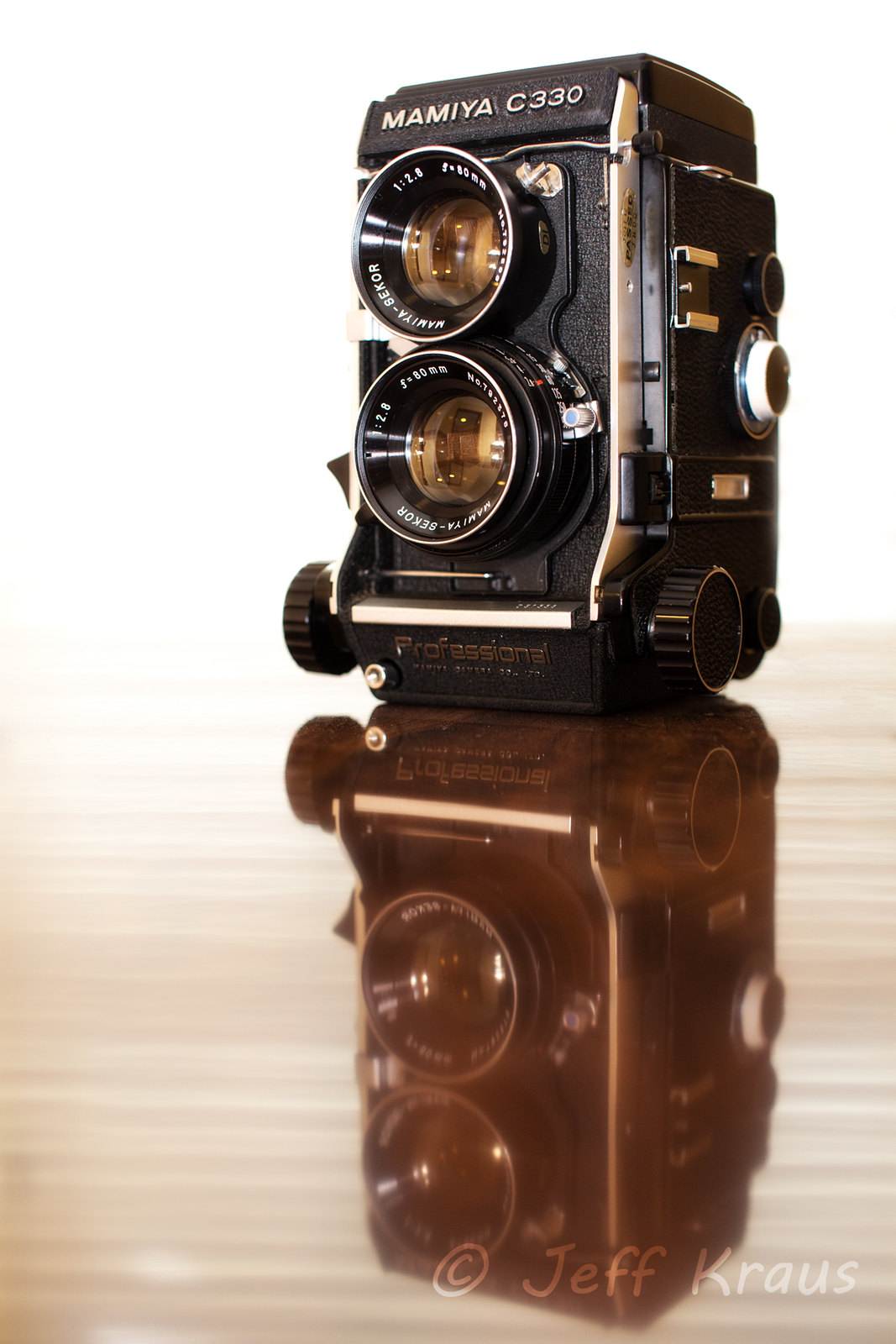
Camera Review: Mamiya C330 Professional

Mamiya C-Series Cameras
The Mamiya C-series TLRs have been around for quite some time, with the original Mamiyaflex C being released in 1956 or 1957. Shortly after that, the line split into two with the C2 and the C3 (the latter being the slightly more advanced model). Subsequent generations continued in this fashion with the C22/C33, and finally C220/C330 and variants (C220f, C330f, C330s).
After the Rolleicord III stole my heart, there was very little chance that it would be my last TLR. The
next focal point for my obsession was the Mamiya C330. After much searching on eBay and Craigslist, I found a near-perfect specimen sporting a Mamiya-Sekor 80mm f/2.8 "Blue Dot" lens pair.
This particular model (with no suffix) was in production from 1969 to 1974. It had several improvements over its predecessor the C33, including support for both 120 and 220 film (by rotating a plate on the film door), and interchangeable focus screens.
Tuesday, June 23, 2015
How Extension Tubes Work
There seems to be a lot of misconceptions out there regarding extension tubes and how they work, and if you're just getting started with them, it can be a little frustrating when you're not getting them to behave how you might expect. I've talked a few people through it to clear up questions they had, so hopefully by writing up a post about it, it will help someone else one day.
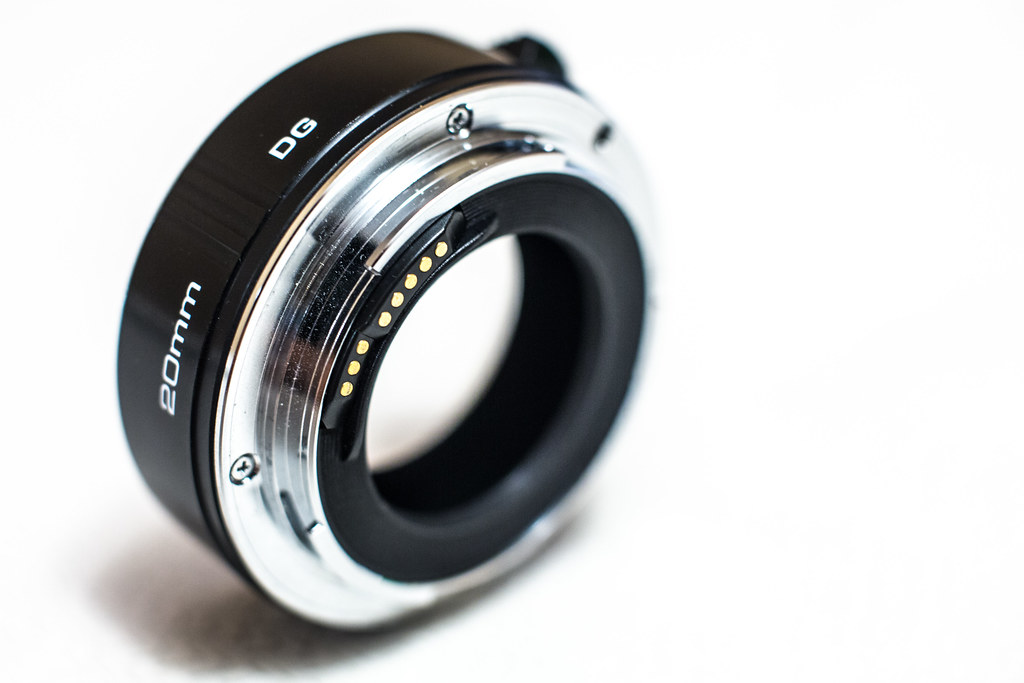
Some years back, I ran across several product reviews for a set of extension tubes that were unnecessarily negative. The main reason was because the users expected to be able to "zoom in" farther with these tubes to allow the subject to better fill the frame. What they were probably thinking of was a teleconverter, which introduces additional lens elements to effectively increase the focal length of the lens it's attached to. Extension tubes are different. They have no optical elements at all; their only purpose is to add additional distance between the lens and the film plane. If you really wanted to, you could actually make your own extension tube with a cardboard toilet paper tube! That's how simple they are.
Extension Tubes Are Just Spacers
| An extension tube |
Wednesday, November 6, 2013
Scanning Negatives vs. Macro DSLR Copying
When I first started getting back into film after well over a decade of digital cameras, I ran across a guy that was absolutely convinced that no scanner could beat his method of "scanning" negatives and slides. He would use a macro lens attached to his digital camera, and photograph the negative in sections, merging them in software later. He posted an outline of his method on this page.
I was intrigued by this (and his amazing results), and decided to give it a try myself. I picked out a random black & white photo (to make reversal easier) that had a good sharp focus point on it. This photo was taken with my Mamiya C330 on Kodak TMax 400 film (120 format, 6x6).
I don't have an Epson V700, but I do have a Canon Canoscan 9000F Mark II to use as a comparison. It doesn't support any transparency larger than 120 film, but at around $150, it's a fraction of the cost. I scanned the frame at a (pretty ridiculous) 4800 dpi, which resulted in an image that was around 11600x11500, or about 127 megapixels. Of course, this is well beyond the limitations of the scanner's optics, but I will scale it down shortly for comparison purposes.
| The test image, a number of books carved into a storefront in Mt. Dora, FL. |
I don't have an Epson V700, but I do have a Canon Canoscan 9000F Mark II to use as a comparison. It doesn't support any transparency larger than 120 film, but at around $150, it's a fraction of the cost. I scanned the frame at a (pretty ridiculous) 4800 dpi, which resulted in an image that was around 11600x11500, or about 127 megapixels. Of course, this is well beyond the limitations of the scanner's optics, but I will scale it down shortly for comparison purposes.
Thursday, October 24, 2013
Taberna del Caballo
My success rate is much lower when I shoot film versus digital, partly because there's no safety net; I can't see if I've screwed up the photo until days later, whereas with a DSLR I can look and retake the photo immediately if I don't like it.
However, occasionally even I manage to get something right (at least, to my eyes).
| Taberna del Caballo, St. Augustine, FL |
Monday, September 9, 2013
Rolleicord In Montréal
I brought a much fuller set of camera gear to Montréal during my latest business trip in March and April. I previously didn't think I'd have the room to pack a full bag of DSLR gear and a second backpack containing my work laptop, but this time around I made it happen. In fact, I was even able to bring along my treasured little Rolleicord III by wedging into a space next to my laptop in the second backpack.
While I didn't have quite as much play time as I had hoped on this trip, I still managed to get out a couple of times to enjoy the cold weather (I'm a Florida native so I can say "enjoy") and occasionally snap a photo or two. To be safe, I had all of the negatives processed before returning home, so there would be no chance of X-ray damage.
While I didn't really come up with anything amazing while I was shooting with this camera, I did end up with a couple of decent shots. I think I might be too worried about being seen as something other than just a guy taking a picture, I don't know. I always want to sit still for a while and concentrate on a scene, gathering information and finding the composition that best speaks to me. Something about this bicycle spoke to me, with its odd mismatched brake levers and weird MacGuyver'ed rear mud guard, half buried in snow and forgotten over the long winter months in Montréal. There was a great photo here, and I knew it as soon as I saw it. But then I quickly started to feel self-conscious, wondering what those people down the street were thinking of this weird guy hanging out by someone's bicycle. Or wondering when someone was going to bust out running down the stairs with a baseball bat, mistaking me for a bike thief or creepy trespasser. As a result of that insecurity, I ended up sticking around just long enough to meter the scene, dial it in, and fire off a shot without spending any time on composing it. It left me with a photo that I didn't really love, and I still wonder what I would have ended up with if only I had spent more time.
Wednesday, May 29, 2013
Pinhole Music Video
I got a beautiful 6x9 wooden pinhole camera for my birthday this year, and while I haven't yet had an opportunity to run out and use it, I have been searching through the interwebs for tips on exposure, etc. I'll be posting about the camera once I have some time with it, but in my searching I found this video that I wanted to share.
It's a music video for London Grammar and the majority of it was shot with a handmade 360º circular rig that surrounds the subject. 35mm film is fed all the way around, and a cloth covering the 625 pinholes is lifted prior to firing a strobe as the subject makes their "move". The black-and-white negative film was then processed on-site in buckets filled with chemicals.
Subscribe to:
Posts (Atom)