Showing posts with label twin lens reflex. Show all posts

Monday, July 13, 2015

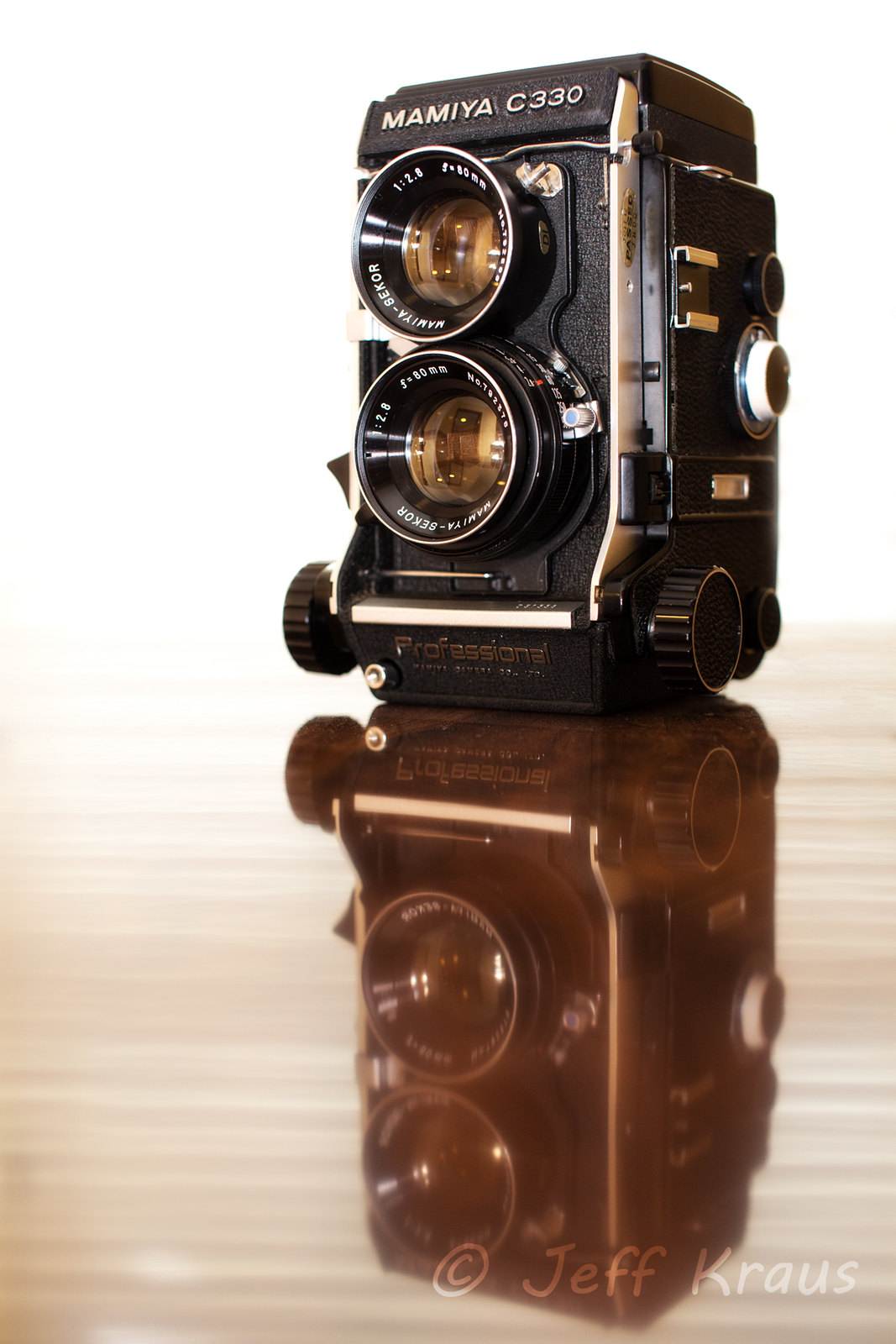
Camera Review: Mamiya C330 Professional


Mamiya C-Series Cameras


The Mamiya C-series TLRs have been around for quite some time, with the original Mamiyaflex C being released in 1956 or 1957. Shortly after that, the line split into two with the C2 and the C3 (the latter being the slightly more advanced model). Subsequent generations continued in this fashion with the C22/C33, and finally C220/C330 and variants (C220f, C330f, C330s).

After the Rolleicord III stole my heart, there was very little chance that it would be my last TLR.  The
next focal point for my obsession was the Mamiya C330. After much searching on eBay and Craigslist, I found a near-perfect specimen sporting a Mamiya-Sekor 80mm f/2.8 "Blue Dot" lens pair.

This particular model (with no suffix) was in production from 1969 to 1974. It had several improvements over its predecessor the C33, including support for both 120 and 220 film (by rotating a plate on the film door), and interchangeable focus screens.

Thursday, October 24, 2013

Taberna del Caballo

My success rate is much lower when I shoot film versus digital, partly because there's no safety net; I can't see if I've screwed up the photo until days later, whereas with a DSLR I can look and retake the photo immediately if I don't like it.

However, occasionally even I manage to get something right (at least, to my eyes).

Taberna del Caballo by jeffk42
Taberna del Caballo, St. Augustine, FL

Monday, September 9, 2013

Rolleicord In Montréal

I brought a much fuller set of camera gear to Montréal during my latest business trip in March and April. I previously didn't think I'd have the room to pack a full bag of DSLR gear and a second backpack containing my work laptop, but this time around I made it happen. In fact, I was even able to bring along my treasured little Rolleicord III by wedging into a space next to my laptop in the second backpack. While I didn't have quite as much play time as I had hoped on this trip, I still managed to get out a couple of times to enjoy the cold weather (I'm a Florida native so I can say "enjoy") and occasionally snap a photo or two. To be safe, I had all of the negatives processed before returning home, so there would be no chance of X-ray damage.

While I didn't really come up with anything amazing while I was shooting with this camera, I did end up with a couple of decent shots.  I think I might be too worried about being seen as something other than just a guy taking a picture, I don't know.  I always want to sit still for a while and concentrate on a scene, gathering information and finding the composition that best speaks to me.  Something about this bicycle spoke to me, with its odd mismatched brake levers and weird MacGuyver'ed rear mud guard, half buried in snow and forgotten over the long winter months in Montréal.  There was a great photo here, and I knew it as soon as I saw it.  But then I quickly started to feel self-conscious, wondering what those people down the street were thinking of this weird guy hanging out by someone's bicycle. Or wondering when someone was going to bust out running down the stairs with a baseball bat, mistaking me for a bike thief or creepy trespasser.  As a result of that insecurity, I ended up sticking around just long enough to meter the scene, dial it in, and fire off a shot without spending any time on composing it.  It left me with a photo that I didn't really love, and I still wonder what I would have ended up with if only I had spent more time.

Wednesday, March 13, 2013

Rolleicord III (K3B) and Focusing Screen

My Rolleicord III, sitting there being all awesome.
The Rolleicord is certainly the camera that got me back into film photography.  My Rolleicord III (along with a Rollei 35 that will surely be the subject of a later post) was given to me as a gift from my stepdad when he was getting rid of some of his unused equipment.

At the time, I had just dug myself even deeper into the digital camp by selling my Canon EOS 5D Mark II and buying the updated Mark III, but I was excited by the unexpected gift and couldn't wait to try it out (even though I knew absolutely nothing about Rollei). Medium format went off my radar when I went digital in 2003 but ever since the day I bought my first 35mm SLR in 1992, it had been a dream of mine. If I had known that quality, affordable 120 cameras like this were around I probably would have started a long time ago!


If you are unfamiliar with twin lens reflex cameras, their operation and build is relatively simple compared to SLR's.  The lower "taking lens" projects the image onto the film when
the shutter opens, and the light from the upper "viewing lens" is projected upward via a 45-degree mirror onto a matte viewing surface which is used to focus and compose.

Thursday, March 7, 2013

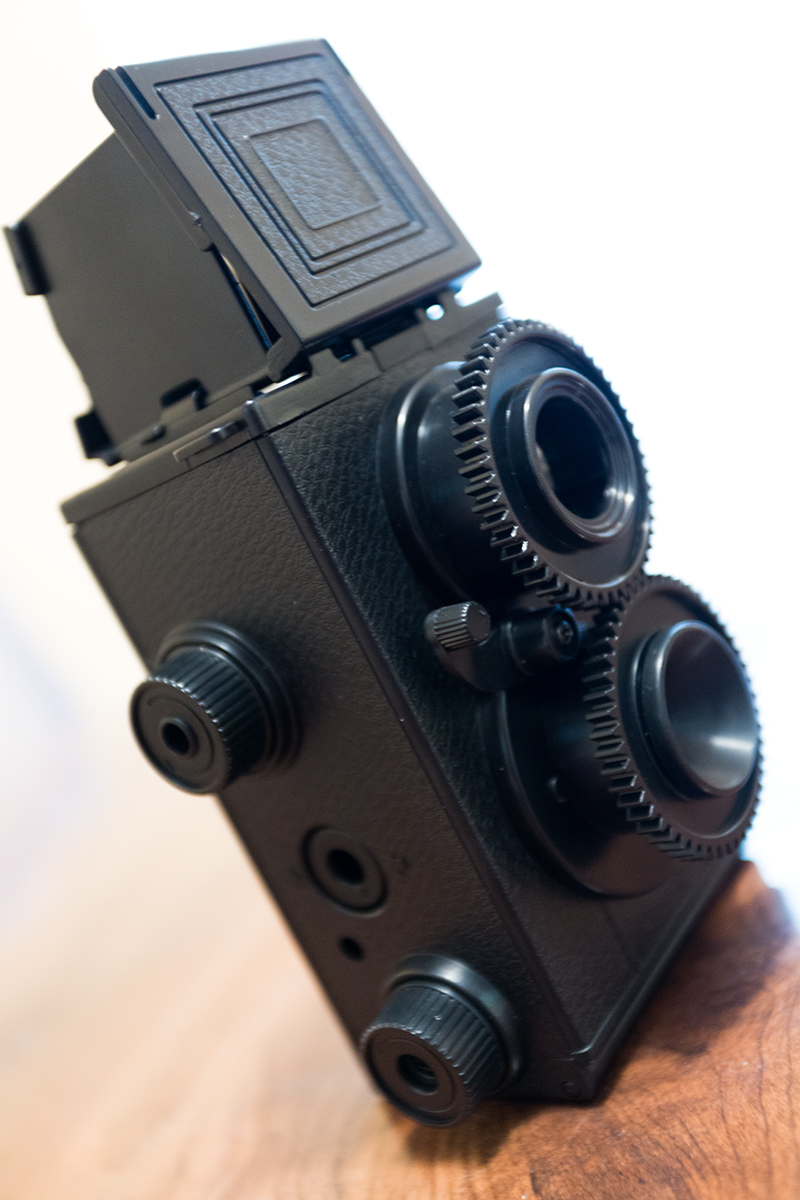
Recesky TLR DIY Kit

Recesky DIY TLR, assembled.
The Recesky DIY TLR fascinates me for some reason. It's basically a super cheap (about US$15) kit that resembles one of those inexpensive airplane model kits that you can get at any hobby shop. Everything is molded plastic, all in the same color, with a few springs and a bag of screws, and two plastic lenses.

Everything is reduced to its component parts, so I found it pretty interesting, especially building out the shutter mechanism. Of course it's tragically basic, but it was still cool to put it all together and see it work.

Once fully assembled, you have a basic, no frills TLR; it has a flip-up hood that you can open to expose the matte waist-level finder, which like any TLR is reflecting an image back from the viewing lens (in reverse). The two lenses are linked by gear teeth so that when the viewing lens is being focused, the taking lens is focused by the same amount.

The shutter trips at what I can only imagine is a somewhat approximate 1/125 second, it's basically a spring-loaded piece of plastic that swings out and springs back when you press down on the shutter release lever, located at the front of the camera.  The aperture is fixed at f/11, so really the only actual exposure control you have is changing up the film speed when you switch rolls.